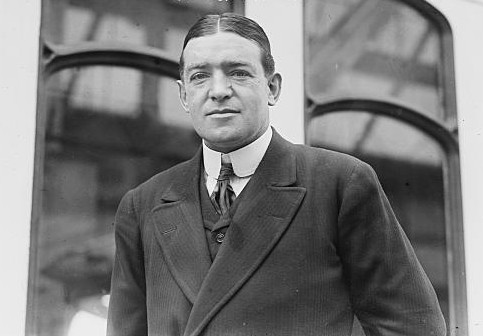
 Bain News Service, publisher, Public domain, via Wikimedia Commons
Throughout history, the world’s most daring explorers have pushed themselves to the very edge of human endurance. Some sought fame, others fortune or knowledge, but many found themselves battling conditions that should have killed them. What sets a few of them apart is not just that they survived, but that they returned to tell the tale, often changing history in the process. These are the stories of explorers who faced the unthinkable and lived to recount it.
Ernest Shackleton
Shackleton’s Antarctic expedition aboard the Endurance is the very definition of survival against the odds. In 1914, the ship became trapped in ice in the Weddell Sea and was eventually crushed. Shackleton and his crew camped on the ice for months before making a daring escape. They rowed to Elephant Island, then Shackleton and five others set off in a lifeboat across 800 miles of treacherous seas to reach South Georgia.
From there, they had to cross a mountain range on foot before finally getting help. Incredibly, every member of the 28-man crew survived. Shackleton’s leadership and refusal to give up made him a legend, and his story remains one of the most extraordinary examples of resilience in the face of extreme hardship.
Douglas Mawson
While lesser known than Shackleton, Australian geologist Douglas Mawson endured one of the most gruelling survival stories in Antarctic history. In 1912, during an expedition, his two companions died, one from falling into a crevasse, the other possibly from ingesting tainted dog liver. Mawson was left completely alone, more than 100 miles from base.
He dragged his sled back across the ice for a month, suffering frostbite, starvation, and exhaustion. At one point, his skin began peeling off. When he finally reached base, the rescue ship had left just hours earlier. He waited another year in Antarctica before returning home. His ordeal became a cornerstone of survival literature.
Hugh Glass
The story of Hugh Glass, a 19th-century American frontiersman, borders on myth, but it’s rooted in truth. In 1823, while scouting on a fur-trading expedition, Glass was mauled by a grizzly bear and left for dead by his companions. With a broken leg, festering wounds, and no weapons, he crawled and limped over 200 miles through the wilderness.
Surviving on wild berries, insects, and the occasional carcass, Glass somehow made it back to a fort. His story inspired the film The Revenant, and while details have been embellished, the core of his survival—alone, badly injured, and driven by sheer will—is undisputed.
Isabella Bird
A Victorian-era traveller and writer, Isabella Bird wasn’t battling bears or sailing stormy seas, but her resilience in the face of illness and danger was unmatched. Suffering from chronic health issues, she travelled alone through places considered unsuitable, even dangerous, for women at the time: from the Rockies to Tibet and Iran.
In Japan, she trekked through remote areas rarely visited by Westerners. In Colorado, she rode solo through snow-covered mountain passes. Her sheer determination and curiosity pushed her past social conventions and physical limits. Despite nearly constant illness, she documented her travels in detail, opening up entire regions to Western readers.
Alexander Selkirk
A Scottish sailor whose real-life experience is said to have inspired Robinson Crusoe, Selkirk was marooned on a deserted island in the South Pacific in 1704 after a dispute with his ship’s captain. He spent four years alone on the island, surviving by hunting goats, catching shellfish, and building shelter.
He read from his Bible daily and learned to tame wild cats to protect himself from rats. When finally rescued in 1709, he was reportedly healthier than the sailors who’d abandoned him. His tale remains one of the most remarkable stories of self-sufficiency and psychological endurance.
Aron Ralston
Though a more modern example, Aron Ralston’s story is no less dramatic. In 2003, while hiking alone in Utah’s Bluejohn Canyon, a boulder shifted and trapped his arm. After five days of being stuck with little water and no way to call for help, he amputated his own arm with a dull multi-tool to free himself.
He then rappelled down a 20-metre drop and hiked several kilometres before being rescued. Ralston’s experience was later depicted in the film 127 Hours. His calm decision-making, combined with an extraordinary pain threshold and sheer determination, make his story one of modern survival legend.
Cabeza de Vaca
In the early 16th century, Spanish explorer Álvar Núñez Cabeza de Vaca was part of a disastrous expedition to colonise Florida. After a series of failures, shipwrecks, and conflicts, only a handful of the original 600 men survived. De Vaca was one of just four who made it back to Spanish territory, after eight years wandering through what is now the American Southwest and Mexico.
He lived among various Indigenous communities, sometimes enslaved, sometimes as a healer or trader. His detailed accounts remain a rare window into early contact between Europeans and Native peoples, and his survival story is both brutal and deeply human.
These explorers didn’t just survive. They endured extremes of isolation, injury, starvation, and exposure that would break most people. Whether navigating frozen seas, uncharted wilderness, or their own failing bodies, they pushed through sheer will, cleverness, and luck. Their stories remind us just how far human beings can go when faced with the impossible, and how history is often written not just by the brave, but by the stubbornly alive.