 Getty Images/iStockphoto
Stonehenge may get all the international fame, but it’s far from the only ancient marvel in Britain—nor, arguably, is it the most awe-inspiring. Across the UK, there are countless prehistoric and early historic sites that are less known but far more complex, mysterious, or visually striking. From massive earthworks to sophisticated settlements, these sites tell a deeper story of early Britain and the people who lived here long before modern records began.
Skara Brae, Orkney
Older than both Stonehenge and the Egyptian pyramids, Skara Brae is one of the best-preserved Neolithic villages in Europe. Buried under sand for thousands of years until a storm revealed it in the 19th century, this 5,000-year-old site offers a glimpse into prehistoric domestic life. The stone-built homes still have furniture, storage spaces, and even drainage systems.
It’s rare to see anything from that era so intact, and what makes it stand out is how relatable it feels. These weren’t ceremonial sites or elite structures; they were everyday homes, complete with hearths and beds. The fact that they’ve survived so well in such a harsh climate makes Skara Brae feel both timeless and strangely intimate.
Maiden Castle, Dorset
Maiden Castle isn’t just one of the largest Iron Age hillforts in Britain. It’s one of the largest in all of Europe. Sprawling across more than 45 acres, the site features multiple layers of defensive earthworks that would’ve made it nearly impossible to breach. Built and expanded between 600 BCE and the Roman conquest, it offers a dramatic window into ancient warfare, power, and social structure.
From its towering ramparts to its commanding views over the surrounding countryside, Maiden Castle feels like it was meant to impress, and intimidate. Archaeological finds suggest it was more than just a military post, possibly including temples, homes, and community spaces.
Avebury, Wiltshire
While Stonehenge may be more iconic, Avebury is bigger, and arguably more mysterious. The stone circle at Avebury is part of a vast Neolithic landscape that includes avenues, burial mounds, and artificial hills like Silbury Hill. What sets it apart is its scale and complexity. You can walk among the stones without fences or viewing platforms, which gives it a completely different energy.
The entire area is packed with prehistoric features that seem to connect in strange and deliberate ways, yet their true meaning remains elusive. Many who visit find Avebury even more spiritually charged than Stonehenge, perhaps because it’s more immersive and less packaged for tourists.
Silbury Hill, Wiltshire
Just down the road from Avebury is Silbury Hill, the largest artificial mound in Europe. Built around 2400 BCE, its scale is staggering, nearly the same height as the Egyptian pyramids, but built entirely from chalk and soil. No one knows exactly why it was constructed, and no burial has ever been found inside.
Its construction would have required enormous labour and planning, yet its purpose remains a mystery. Religious monument? Territorial marker? Ancient show of power? Whatever the case, the effort involved in building Silbury Hill suggests it held immense importance to those who built it.
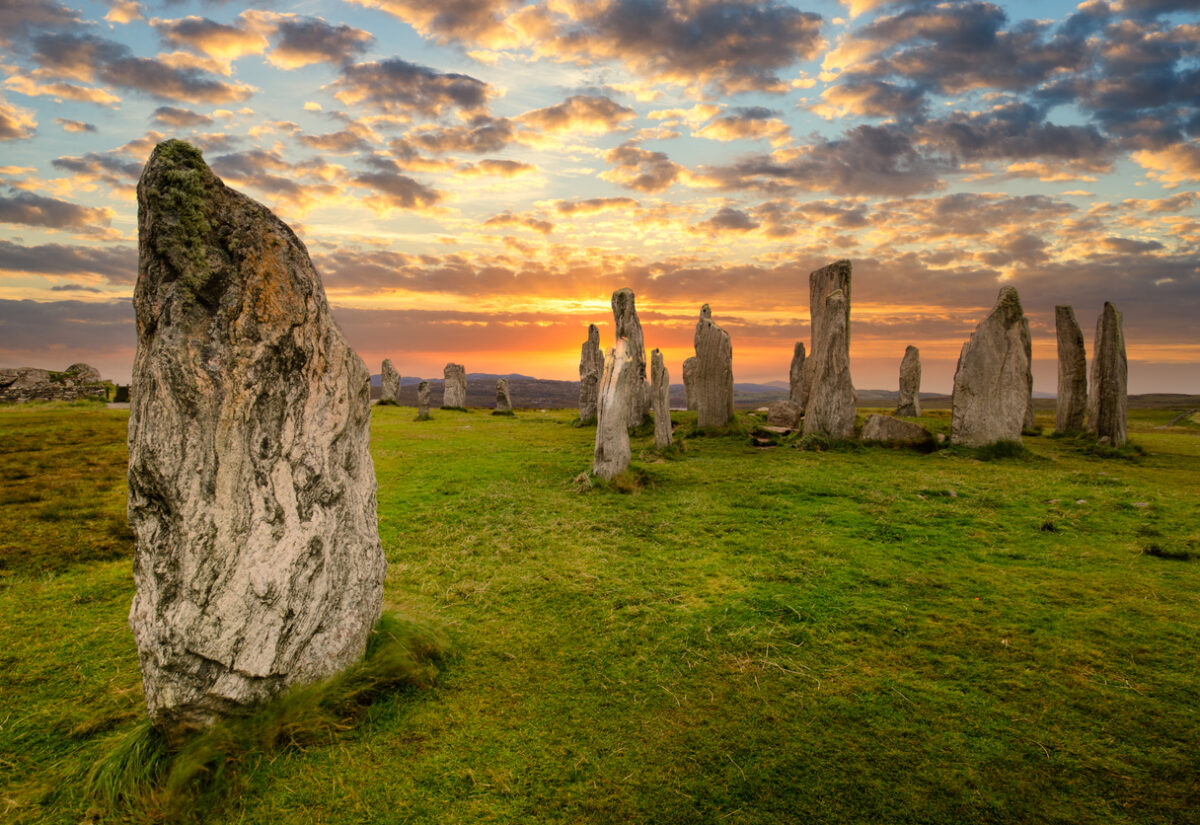
Callanish Stones, Isle of Lewis
Callanish Stones, Isle of Lewis
On the windswept western edge of Scotland stands the Callanish stone circle, older than Stonehenge and arguably more striking in its wild setting. Unlike the neatly arranged symmetry of Stonehenge, Callanish has a more organic feel—its tall, thin stones stretch out in a cruciform pattern, anchored by a central circle.
Shrouded in local legends and surrounded by lochs and moorland, the Callanish Stones have long inspired myth and speculation. Some suggest they align with lunar cycles; others believe they were ceremonial meeting places. Whatever their function, the setting alone gives them a haunting, unforgettable presence.
Broch of Mousa, Shetland
The Broch of Mousa is a truly remarkable structure, an Iron Age round tower that still stands almost to its original height of 13 metres. Built around 300 BCE, it’s the best-preserved broch in existence and offers a rare opportunity to step inside a prehistoric building that still feels structurally whole.
Its drystone construction is so precise that the tower has remained intact without mortar for over two millennia. The inner staircase spirals up between two stone walls, and its sheer height and complexity make you question how such a feat was achieved with limited tools and technology.
Stanton Drew, Somerset
Often overshadowed by Stonehenge and Avebury, the Stanton Drew stone circles are among the largest in Britain. The Great Circle alone is 113 metres in diameter, significantly larger than Stonehenge. What’s especially fascinating is that most of the site remains unexcavated, so much of its history is still hidden underground.
Geophysical surveys have revealed buried features like pits and postholes, suggesting a complex ceremonial layout. The mystery of Stanton Drew is what makes it so compelling. It hints at an entire world of ritual and meaning that archaeologists have only just begun to uncover.
Old Sarum, Wiltshire
Old Sarum may not be as old as Stonehenge, but it’s a unique layer-cake of British history that predates the medieval period. The site began as an Iron Age hillfort before being used by the Romans, Saxons, and Normans. At one point, it held a royal palace and the original Salisbury Cathedral.
The way Old Sarum brings together different eras in one dramatic location makes it more than a ruin. It’s a record of how power, faith, and military strategy evolved across centuries. The sweeping views from the ramparts only add to its gravitas.
The Ness of Brodgar, Orkney
Still under excavation today, the Ness of Brodgar is one of the most exciting Neolithic discoveries in recent British history. Located between the Ring of Brodgar and the Stones of Stenness, it was once a major ceremonial and possibly political centre.
What makes the Ness so extraordinary is the scale and complexity of its structures. The site includes intricately built stone buildings, painted walls, and evidence of large-scale feasting. Some archaeologists believe it may have played a similar role in Neolithic society to what Rome did in later times—central, powerful, and symbolically loaded.
Stonehenge will always have its place in the public imagination, but it’s far from the whole story. Britain is covered in ancient marvels that show the ingenuity, creativity, and complexity of prehistoric societies. Whether it’s an eerie stone circle on a Hebridean isle or a massive chalk hill built by hand, these sites reveal a civilisation that was far more advanced, and far more fascinating, than they’re often given credit for.