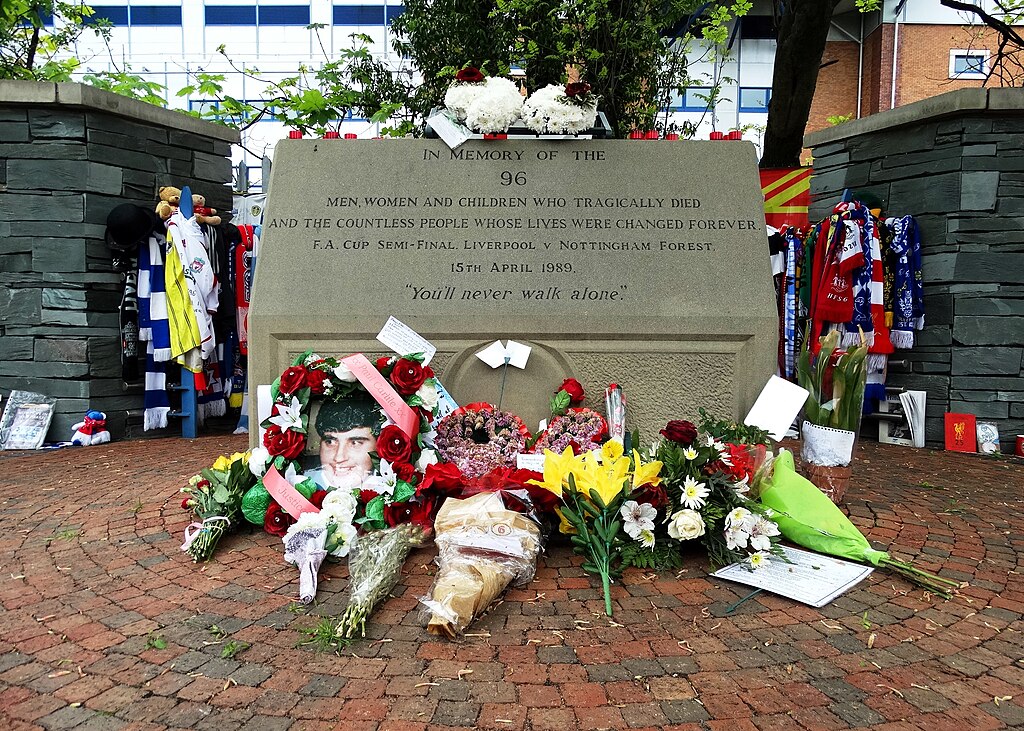
 Hillsborough Disaster Memorial Stone by Neil Theasby, CC BY-SA 2.0 , via Wikimedia Commons
Britain’s legal system is famously old, but many of the protections and principles we take for granted today came about because something went horribly wrong. From wrongful executions to public scandals that rocked the nation, here are the historical crimes that pushed the justice system to evolve, modernise, and in some cases, admit it got things terribly wrong.
The wrongful execution of Timothy Evans (1950)
Timothy Evans was hanged for the murder of his wife and baby daughter, only for it to be revealed later that the real killer was his neighbour, John Christie, a serial murderer who had used the same house to kill multiple women. Evans had maintained his innocence, but was convicted largely on Christie’s testimony.
The Evans case became one of the most notorious miscarriages of justice in British history, and public outcry contributed heavily to the movement to abolish the death penalty. In 1965, capital punishment for murder was suspended in Britain, and formally abolished in 1969.
The trial and execution of Derek Bentley (1953)
Bentley, aged 19 with developmental disabilities, was convicted of murder under the principle of “joint enterprise” after his 16-year-old accomplice shot and killed a police officer during a failed robbery. Despite not firing the gun himself, Bentley was hanged.
His case became a symbol of injustice, especially given his mental state and the questionable conduct of the trial. It sparked debates over how the law treats young offenders and helped further turn the public against the death penalty.
The Guildford Four and Birmingham Six (1970s)
In the 1970s, amid IRA bombings on British soil, police scrambled for arrests. The Guildford Four and Birmingham Six were wrongly convicted of bombings that killed dozens. Their confessions were coerced, evidence was ignored or fabricated, and the media painted them as guilty from the start.
They spent up to 16 years in prison before their convictions were quashed. These scandals led directly to the establishment of the Criminal Cases Review Commission in 1997, an independent body to investigate alleged miscarriages of justice.
The case of Ruth Ellis (1955)
Ruth Ellis was the last woman to be hanged in Britain. She killed her abusive lover in a moment of passion, and her trial and execution ignited a fierce national debate. Many saw her as a victim of domestic violence who had been failed by the system.
Her case forced the country to examine how it dealt with women, abuse, and mental health in the courtroom. While not the only factor, it added pressure to reconsider the death penalty and change how courts viewed domestic circumstances.
The Profumo affair (1963)
While not a criminal case in the traditional sense, the scandal surrounding Secretary of State for War John Profumo’s affair with Christine Keeler, who was also involved with a Soviet naval attaché, shook the British establishment.
The resulting fallout exposed corruption, lies, and manipulation at the highest levels of government. It pushed for reforms in political accountability and media transparency, and set the stage for more public scrutiny of public officials.
The murder of Stephen Lawrence (1993)
Stephen Lawrence, a Black teenager, was murdered in a racially motivated attack while waiting for a bus in south-east London. The police investigation was botched, with delays, incompetence, and racism all contributing to years of inaction. The Macpherson Report in 1999 concluded that the Metropolitan Police was institutionally racist—a finding that rocked British policing. It led to sweeping reforms in how police investigate hate crimes and interact with minority communities.
The Hillsborough disaster cover-up (1989)
Ninety-seven football fans died in a crush at Hillsborough Stadium, and for years the victims’ families fought to uncover the truth. Initial police reports blamed the fans, but it later emerged that authorities had altered statements and manipulated evidence to avoid blame.
The eventual inquest verdict of unlawful killing came after decades of campaigning. The scandal led to major changes in how public institutions are held accountable and contributed to the overhaul of inquest procedures and public inquiry standards.
The case of Barry George (2001)
Barry George was convicted of murdering TV presenter Jill Dando based on flimsy evidence and spent eight years in prison before being acquitted in a retrial. His wrongful conviction highlighted the dangers of relying on circumstantial and forensic evidence without strong context.
The case renewed conversations around media pressure, wrongful arrest, and how high-profile crimes can lead to miscarriages of justice if due process is sidelined.
Operation Midland and false abuse claims (2010s)
The Metropolitan Police launched Operation Midland based on false claims of a VIP paedophile ring operating at the heart of government. The investigation, fuelled by the media and lacking hard evidence, damaged reputations and wasted public funds.
The fallout triggered scrutiny into how allegations are investigated and the importance of corroboration before publicising or prosecuting claims. It led to changes in police procedure and greater scepticism about basing cases solely on unverified witness testimony.
The Post Office Horizon scandal (2000s–2020s)
Hundreds of sub-postmasters were wrongly prosecuted for fraud due to errors in the Horizon IT system. Some lost everything—homes, reputations, even their freedom. The scandal is now regarded as one of the worst miscarriages of justice in British legal history.
The scale of the failure has led to ongoing calls for legal reform, compensation schemes, and public inquiries. It’s still unfolding, but it’s already had a huge impact on how digital evidence is handled and how corporate accountability intersects with criminal law.
Many of the rights, procedures, and oversight mechanisms in modern British justice weren’t created proactively. They were dragged into existence by injustice. These cases are reminders that the legal system, like any human institution, is fallible. But they also show the power of public pressure, journalism, and sheer persistence in driving change. Each of these crimes didn’t just shake Britain at the time, they reshaped its future.