Bizarre Funeral Practices Throughout History That Have Thankfully Disappeared
- July 3, 2025
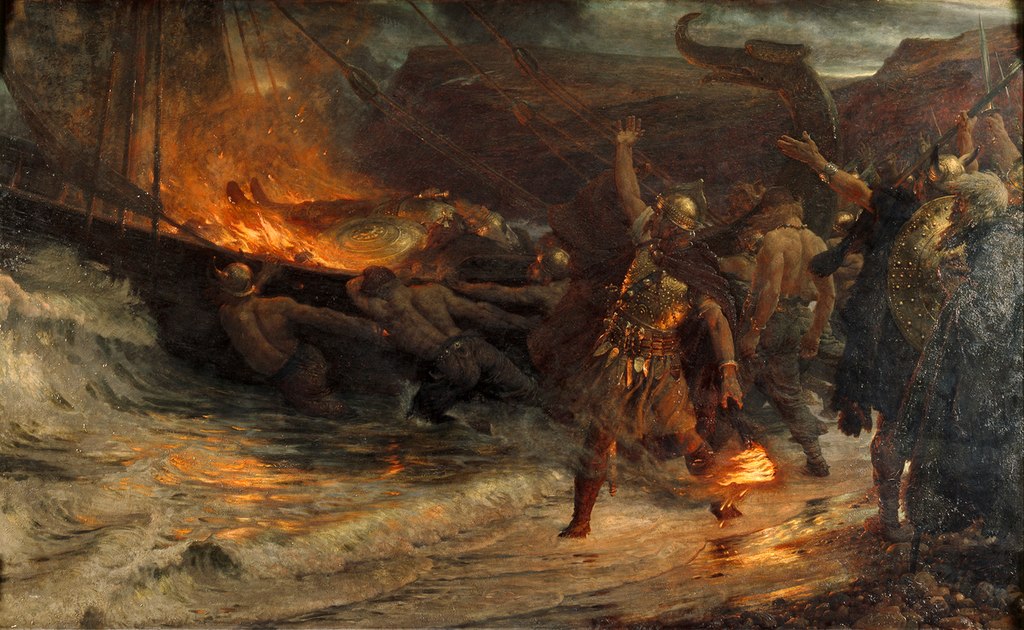 Frank Bernard Dicksee, Public domain, via Wikimedia Commons
Death has always inspired rituals—some beautiful, some haunting, and others downright strange. Across the centuries, people have come up with a range of funeral practices to honour the dead, ease their passage to the afterlife, or keep their spirits from causing trouble. Many of these customs were shaped by religion, superstition, geography, or local culture. And while some have quietly faded from use, they leave behind stories that are as fascinating as they are strange.
Sin-eating in Wales and the border regions
In parts of 17th and 18th century Wales and along the English border, families used to hire a ‘sin-eater’—a poor villager paid a few coins and a meal to eat bread and drink ale over a corpse. This ritual was thought to absorb the dead person’s sins, cleansing their soul and allowing them to pass into heaven.
The sin-eater would sit at the side of the body, sometimes with their hands on the chest of the deceased, as they consumed the food. It was a symbolic act of taking on the spiritual burden of the dead. The custom was never officially sanctioned by the Church and was considered blasphemous by many, yet it persisted quietly for generations. The last known sin-eater is believed to have died in the early 20th century.
Viking funerals involving human sacrifice
While the image of a flaming longship drifting out to sea has captured the modern imagination, historical Viking funerals could be far more brutal. For high-status men, particularly chieftains, slaves, or concubines were sometimes killed and buried or burned with the body.
Accounts from Arab chroniclers like Ahmad ibn Fadlan described these ceremonies in vivid detail: drugged women would be strangled or stabbed to accompany their masters into the afterlife. The ship burials were dramatic, loaded with weapons, animals, and offerings, then either buried in mounds or sent out on water and set alight. Though this wasn’t the norm for every Viking, it was a real and gruesome part of some funerals.
Post-mortem photography in Victorian Britain
In the 19th century, it became popular in Britain and parts of Europe to take photographs of the recently deceased. Known as post-mortem photography, this practice was partly due to the high cost of photography and the frequency of early deaths. It was often the only image a family had of a loved one.
Bodies were dressed, posed—sometimes standing, often seated—and propped up to look as lifelike as possible. Eyes were painted onto closed eyelids, limbs were supported by stands, and backgrounds were designed to look domestic or natural. While the intent was sentimental, it can feel eerie to modern eyes. It eventually fell out of fashion as photography became more accessible and death less visible in the home.
Skull collection and display in the Andes
In parts of ancient Peru and Bolivia, skulls of ancestors were kept in the home and brought out during ceremonies or seasonal events. These skulls were seen not as macabre but as powerful spiritual connections. Some were given names, adorned with flowers or hats, and treated as family.
Even today in Bolivia, the Day of the Skulls, or Dia de las Ñatitas, is celebrated by people bringing skulls (real or symbolic) to cemeteries, lighting candles, and offering food or cigarettes to honour their protective presence. While modern practices are less extreme, the older customs often involved digging up bones and keeping them visible year-round.
Endocannibalism among the Wari’ and Fore peoples
In some Indigenous communities, most notably the Wari’ of Brazil and the Fore of Papua New Guinea, funerary cannibalism was a deeply spiritual practice. Among the Wari’, it was considered more respectful to consume the flesh of a loved one than to bury or burn them, which was seen as leaving them to rot or be eaten by animals.
The Fore people engaged in similar rituals, especially involving female relatives consuming the brain. Tragically, this practice led to the spread of a degenerative disease known as Kuru, similar to mad cow disease, which decimated entire communities before it was understood and stopped. While shocking now, these customs were acts of mourning and reverence, not violence.
Binding and mutilating the dead to stop them rising
In various parts of medieval Europe, people believed the dead could come back, either as vengeful spirits or literal walking corpses. To prevent this, graves were sometimes filled with heavy stones, iron bars, or even decapitated bodies. In some cases, corpses were pinned with stakes, their mouths filled with rocks or coins, or their tendons slashed.
Archaeologists have found graves where skeletons show signs of deliberate mutilation long after death. These were acts of fear, not cruelty. Vampiric folklore and superstitions about restless souls fed these beliefs, especially during plagues or famines. It’s a grim reminder of how fear can shape even the most sacred rituals.
Sky burials in Tibet and Mongolia
In the high-altitude regions of Tibet and Mongolia, the rocky ground made burial impossible and wood for cremation was scarce. Instead, sky burials became the traditional method. The body would be placed on a mountain and cut into pieces by ritual specialists, then left for vultures to consume.
This practice was grounded in Buddhist belief—the body is seen as an empty vessel, and feeding birds is an act of generosity. While it might seem shocking, it’s deeply spiritual and still practised today in some areas. However, earlier versions were less formalised, and in times of war or famine, bodies were left with minimal rites, leading to more chaotic and unsettling scenes.