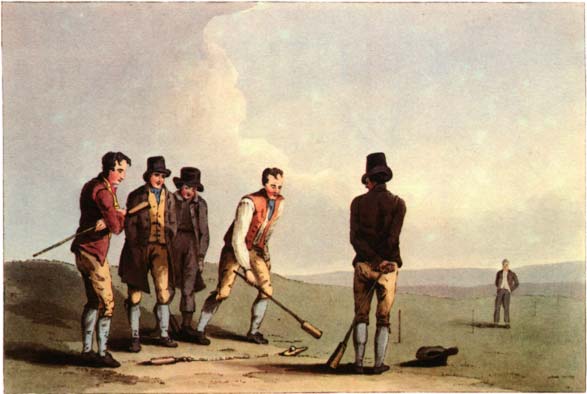
 From George Walker's book The Costume of Yorkshire, first published in 1814., Public domain, via Wikimedia Commons
Britain has always had a talent for inventing strange games. Long before football and cricket took over the spotlight, local communities across the UK played all sorts of oddball sports—some violent, some hilarious, and many completely baffling by today’s standards. These weren’t just passing fads either; some were huge regional events with their own rules, rituals, and die-hard fans. But over time, many of them faded into obscurity. These are just some of the bizarre British sports that have all but vanished.
Fox tossing
It’s as strange and grim as it sounds. Fox tossing was once a popular spectacle among the 17th-century European aristocracy, including some pockets of Britain. The premise? Participants stood on either side of a large cloth laid out on the ground. When a live fox was released onto it, they’d yank the cloth to catapult the animal into the air. Points were awarded for height. Unsurprisingly, this brutal sport didn’t survive into modern times, partly due to its cruelty and partly because it was more spectacle than actual competition. Still, it’s a chilling reminder of how entertainment once looked very different.
Cudgel playing
Cudgel playing was essentially organised stick fighting. Opponents would face off with short wooden clubs, aiming to strike the other’s head. The first to draw blood was declared the winner. It was less about brute strength and more about speed and precision. Popular across parts of southern England, it was even considered a rite of passage for young men in some areas. But changing attitudes towards violence, alongside safer alternatives for public competition, saw it fade from view by the 19th century.
Shrovetide football (in its original form)
While a modern version of Shrovetide football still survives in Ashbourne, Derbyshire, the original game was a chaotic, town-wide free-for-all played across fields, rivers, and streets. There were few rules, dozens or even hundreds of players, and goals that could be miles apart. The game often lasted all day, and injuries were common. At its peak, it was part of pre-Lenten festivities across the country. Eventually, the sheer scale of the thing, combined with growing concerns about public safety, led many towns to drop the tradition or tone it down considerably.
Knurr and spell
A favourite in parts of Yorkshire, knurr and spell involved using a bat to strike a small ball (the “knurr”) launched into the air by a spring-loaded trap (the “spell”). Players aimed for maximum distance, with strong wrists and good timing being essential. Think of it as a cross between golf and baseball. It was once a serious pastime with local championships and dedicated pitches, but the rise of more standardised sports—and perhaps the complexity of its setup—saw it decline dramatically by the early 20th century.
Shin kicking
Yes, this was exactly what it sounds like. Dating back to the early 17th century, shin kicking involved two opponents holding each other by the shoulders and attempting to kick each other in the shins until one fell over. It was often part of larger village celebrations or festivals. Participants sometimes wore steel-toed boots or packed their trousers with straw for protection. Despite sounding completely bonkers, shin kicking held on longer than you’d think—it was still being performed competitively in the 20th century before finally fizzling out in most places.
Stoolball
Stoolball may well have been an early ancestor to cricket. It was traditionally played by milkmaids, using a milking stool as a wicket. One player would defend their stool while the other threw a ball at it. Versions of the game varied, and some included bats, scoring systems, or teams. In the 17th century, it was even popular among nobility and was one of the few games where men and women regularly played together. While a very niche version of stoolball survives in parts of Sussex, its widespread popularity is long gone.
Quintain tilting
This medieval sport was a form of practice for knights, involving a rotating target mounted on a pole—often with a shield on one side and a sandbag on the other. Riders would gallop towards it with a lance and try to strike the shield. If they missed or hit it poorly, the sandbag would swing round and knock them off their horse. Originally a way to train for jousting, it became a public sport and fairground attraction before fading out with the decline of mounted combat.
Bat and trap
Popular in Kent and Sussex, bat and trap was a pub game that dated back to the 17th century. A ball was launched into the air by hitting a wooden trap door, and the player had to hit it again mid-air towards a set of posts. If the ball went between the posts, it was considered a scoring shot. It was often played on village greens or behind pubs, but changes in leisure habits and the rise of televised sport meant it eventually lost ground.
Camping (not what you think)
This wasn’t about tents and campfires. In East Anglia, “camping” referred to a form of early mob football that also included elements of wrestling and handball. It was rough, lawless, and local pride was on the line. Whole villages turned out to support their teams, and it could get pretty brutal. While popular in the 16th and 17th centuries, its violent nature and lack of formal structure meant it didn’t transition well into modern times.
What happened to them?
Many of these sports disappeared not because they weren’t fun, but because the world around them changed. Urbanisation made sprawling village-wide games impractical. Changing attitudes towards cruelty, violence, and public disorder made others socially unacceptable. And as more formalised sports gained national and global appeal, the quirky regional ones were gradually forgotten. But they’re still part of Britain’s rich and occasionally ridiculous sporting heritage, and a reminder that competition used to look very different.