 Unsplash/Florian Delee
The ancient Maya civilisation is best known today for its grand pyramids, mysterious calendar, and intricate writing system, but what often gets overlooked is just how advanced their science and engineering truly were. Long before many of the inventions celebrated in European history, the Maya had already developed systems and tools that reveal an astonishing understanding of mathematics, architecture, agriculture, and astronomy. Here’s a closer look at some of the most impressive technologies they mastered centuries before European “discovery” narratives began to dominate history.
Advanced water management systems
In the Maya lowlands, where rainfall was seasonal and rivers were scarce, the civilisation developed highly advanced systems for collecting, storing, and distributing water. They built intricate reservoirs, channels, and filtration systems to ensure a year-round supply. At sites like Tikal and Palenque, archaeologists have found vast underground cisterns lined with plaster and covered to prevent evaporation.
These systems weren’t just practical; they reflected a sophisticated understanding of hydraulics and environmental engineering. In some cases, the Maya even added crushed quartz and other materials to create rudimentary water purification methods, something that wouldn’t appear in European cities for centuries.
A precise and complex calendar system
While the Gregorian calendar dominates the Western world today, the Maya were already tracking celestial movements with remarkable accuracy more than a thousand years earlier. Their calendar system used multiple interlocking cycles: the Tzolk’in (a 260-day ritual calendar), the Haab’ (a 365-day solar calendar), and the Long Count, which tracked larger spans of time.
This calendar wasn’t just symbolic. It was based on close observations of solar and planetary movements and was used to time everything from crop planting to religious festivals. In terms of astronomical precision, it rivalled or even surpassed the early European models used by medieval scholars.
Zero and advanced maths
The concept of zero didn’t reach Europe until centuries after the Maya had already been using it. As early as the 4th century CE, the Maya had a fully functioning place-value number system, including a symbol for zero, allowing them to perform complex calculations for trade, architecture, and astronomy.
Their mathematical system was vigesimal, based on 20 rather than 10, and written using dots and bars that could easily be stacked or combined to represent large numbers. This clarity and flexibility gave Maya mathematicians a powerful tool to track cycles and model the universe in ways that wouldn’t become common in Europe until long after contact.
Astronomical observatories and predictive models
The Maya didn’t just look at the stars, they studied them systematically and built structures to observe and align with celestial bodies. The observatory at Chichén Itzá, often called El Caracol, is one of the most famous examples. Its windows are aligned with the paths of Venus and the sun, allowing priests and astronomers to track key movements and predict eclipses.
Maya records show they followed Venus’s cycle with astonishing precision, tracking its phases to within hours of modern calculations. They used this knowledge for ceremonial timing and political decisions, integrating astronomy deeply into every part of their civilisation.
Rubber production and vulcanisation
Long before Charles Goodyear was credited with discovering vulcanisation in the 19th century, the Maya had already developed a method for producing rubber from latex and mixing it with other plant materials to make it durable. They used rubber to create balls for the Mesoamerican ballgame, waterproof textiles, sandals, and various tools.
This early form of chemical processing shows not only practical ingenuity but also a sophisticated knowledge of natural materials, knowledge that Europe wouldn’t stumble upon until millennia later. The fact that these techniques were developed without modern chemistry speaks volumes about the empirical traditions of Maya science.
Monumental architecture without metal tools
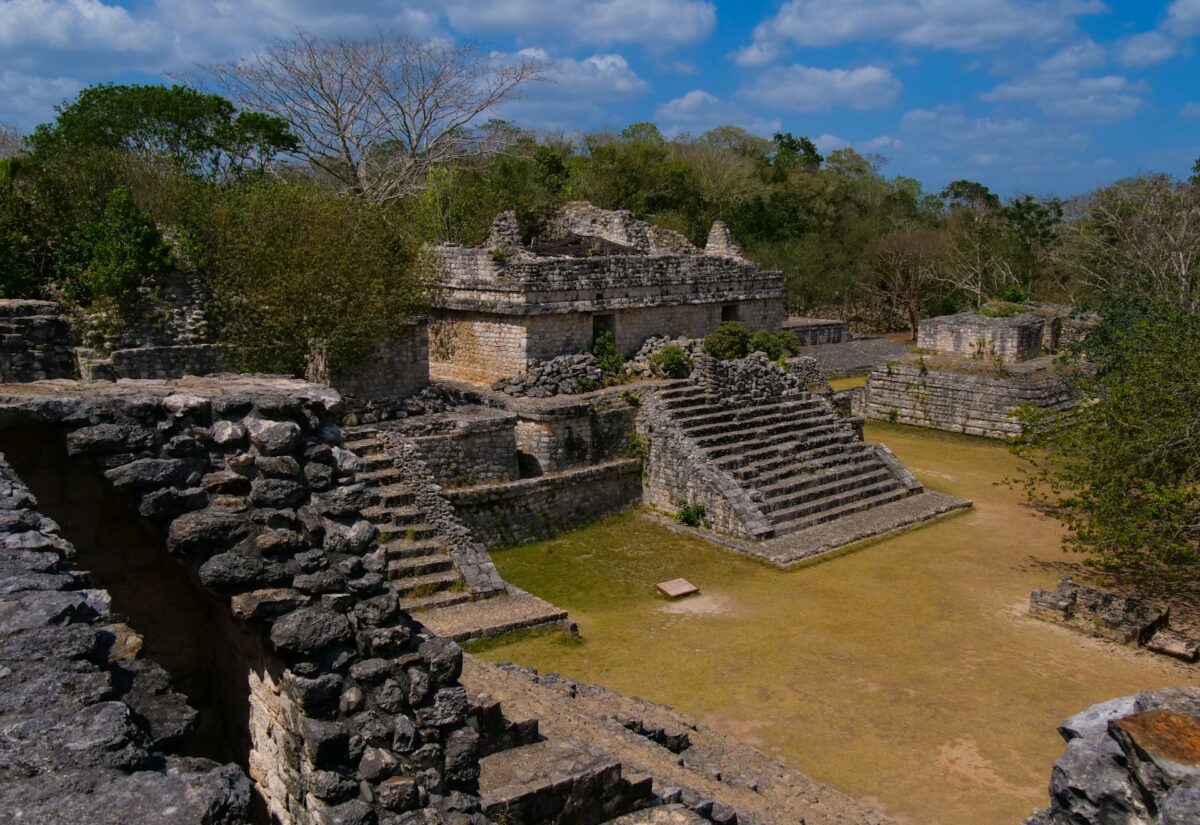
Despite having no metal tools or beasts of burden, the Maya built massive cities, pyramids, and ceremonial platforms with a level of planning and precision that still baffles modern engineers. Structures like the Temple of the Inscriptions in Palenque and the pyramids of Tikal were laid out using advanced surveying techniques and built to astronomical alignments.
They used tools made from obsidian and other hard stones, along with a deep understanding of geometry and acoustics. Some temples were built in such a way that a single clap from below would echo in the shape of a bird call. Intentional sound engineering that relied purely on trial, error, and a masterful grasp of spatial acoustics.
Agricultural engineering and forest management
The Maya didn’t simply clear forests to farm; they managed entire landscapes. Through a combination of terracing, raised fields, canal systems, and crop rotation, they developed resilient systems for food production that supported millions.
More impressively, they practised what we now call agroforestry, selectively planting and maintaining useful tree species while allowing the rest of the forest to regenerate naturally. Their approach to managing the land was deeply sustainable, and it challenges the myth that pre-Columbian civilisations didn’t have large-scale agricultural knowledge.
Sophisticated writing and record-keeping
The Maya developed one of the most advanced writing systems in the ancient world, using a combination of logograms and phonetic symbols to record events, astronomy, politics, and myth. These records were inscribed on stone stelae, painted on ceramics, and written in codices.
Although many of their books were destroyed by Spanish colonisers, those that survived, such as the Dresden Codex, show a civilisation with a deep intellectual culture. The codices include complex astronomical charts, calendars, and ritual texts that reveal how integrated their writing was with science, history, and belief.
The achievements of the Maya were not only remarkable, they were ahead of their time in ways the Western world has only recently come to appreciate.
For centuries, colonial narratives minimised or dismissed the depth of Indigenous science and engineering. But with ongoing archaeological discoveries and modern research, it’s becoming increasingly clear that the Maya weren’t just building monuments—they were developing technologies that rivalled anything seen in ancient Europe. In many cases, they were centuries ahead.