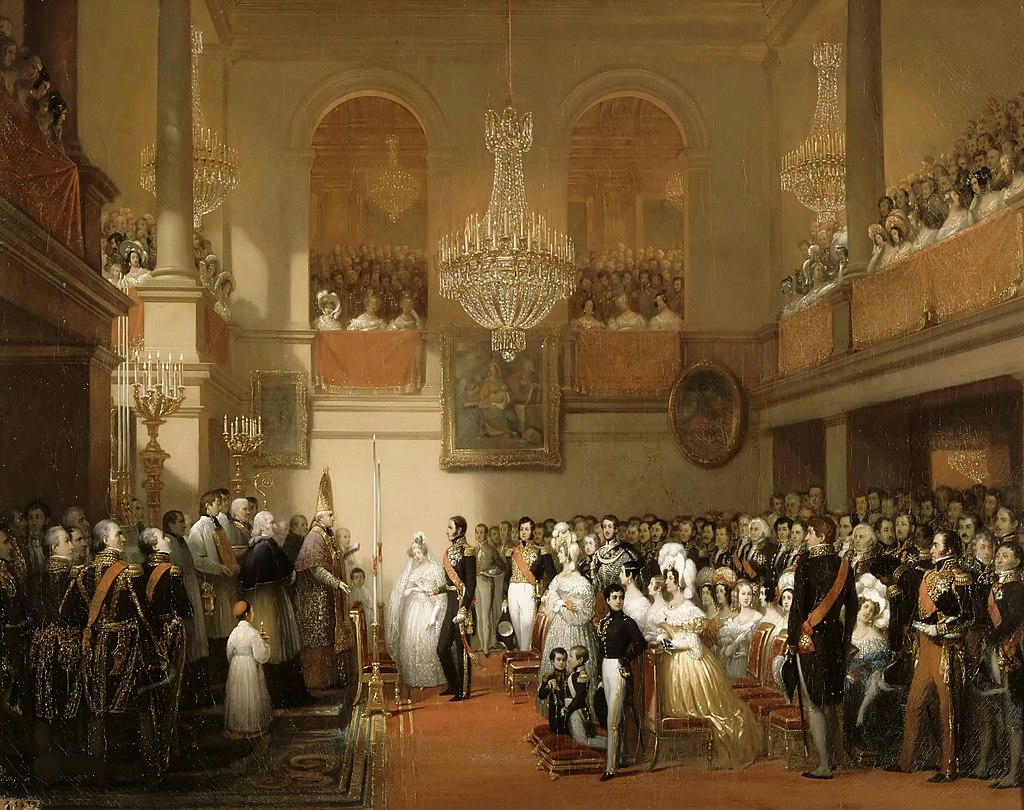
 Joseph-Désiré Court, Public domain, via Wikimedia Commons
For most of history, royal marriages were less about romance and more about politics. Alliances, land, power, and dynastic continuity took precedence over personal feelings. But now and then, amidst all the negotiation and calculation, genuine love stories emerged. Some monarchs defied expectations, scandalised their courts, or changed the course of history by marrying for affection rather than convenience. These royal couples proved that even within the most rigid structures, real connection could flourish.
Queen Victoria and Prince Albert
Few royal marriages are as well-known or as heartfelt as that of Queen Victoria and Prince Albert. Married in 1840, Victoria was utterly devoted to her husband from the start, famously proposing to him herself because royal protocol dictated that a queen had to do the asking.
Their partnership was one of mutual admiration and deep emotional intimacy. Albert supported her reign, took on meaningful public work, and helped reform the monarchy’s public image. His early death in 1861 devastated Victoria, and she mourned him in black for the rest of her life. Despite their aristocratic backgrounds, theirs was a marriage that would not have been out of place in a romantic novel.
King George VI and Elizabeth Bowes-Lyon
When Prince Albert, later George VI, fell in love with Elizabeth Bowes-Lyon, she wasn’t keen on the idea of royal life. She turned down his proposals twice, not because she didn’t care for him, but because she was reluctant to give up a private life for the demands of the monarchy. Eventually, she said yes, and they married in 1923.
Their relationship was marked by stability, affection, and mutual respect. During the Second World War, Elizabeth (later the Queen Mother) stood by George’s side as he faced his unexpected role as king after the abdication of his brother Edward VIII. Their strong personal bond gave him the courage to lead Britain through its darkest hour.
Tsar Nicholas II and Alexandra Feodorovna
Nicholas II of Russia and Alexandra Feodorovna (born Princess Alix of Hesse) had a love story that defied imperial expectations. When Nicholas declared his intent to marry Alexandra, there was resistance from his family and political advisers, who preferred a more politically advantageous match. But Nicholas was steadfast, and they wed in 1894.
Their marriage was based on mutual devotion, although it was also marked by tragedy. The couple were extremely close, sometimes to the point of insularity, and shared a deep spiritual bond. Alexandra’s influence, particularly her trust in the mystic Rasputin, was controversial and contributed to their political downfall. But throughout their reign and up to their execution in 1918, their love for one another remained unshaken.
Prince Mahit and Srinagarindra of Thailand
In the early 20th century, Prince Mahit of Thailand fell in love with a Thai student nurse named Sangwan Talapat while studying medicine in the United States. Their courtship was unusual, not only because they met abroad, but because she was a commoner. Despite opposition, Mahit was determined to marry her.
The two returned to Thailand and married in 1920. After Mahit’s early death, Sangwan, who later became Princess Srinagarindra, went on to become a beloved royal figure in her own right. Their son, Bhumibol Adulyadej, would become the longest-reigning monarch in Thai history. Their marriage was rooted in shared experience, affection, and mutual respect.
King Leopold I and Louise-Marie of Orléans
The first king of Belgium, Leopold I, was widowed after the death of Princess Charlotte of Wales. When he married again, it was to Princess Louise-Marie of Orléans, daughter of King Louis-Philippe of France. Though their marriage had political value, it was also a deeply personal match.
Despite early differences and Louise-Marie’s initial hesitation about moving to a new country, their relationship grew into a warm and affectionate bond. She supported him through the challenges of building a new monarchy and raising a royal family from scratch. Their letters reveal a partnership that was filled with emotional warmth and respect.
Prince Carl of Sweden and Princess Ingeborg of Denmark
In the late 19th century, Prince Carl of Sweden fell in love with Princess Ingeborg of Denmark, and their 1897 marriage was one of genuine affection. Both came from royal families, but their union wasn’t forced or arranged; they were allowed to marry for love.
They had a happy and stable marriage, raising several children and living a relatively low-profile royal life compared to some of their peers. Their daughter Märtha would later marry the future king of Norway, tying the Scandinavian royals even closer together. Carl and Ingeborg’s relationship was built on compatibility and kindness, which was a welcome contrast to the more transactional matches of the time.
Pedro I of Brazil and Maria Leopoldina of Austria
Pedro I, the first Emperor of Brazil, married Archduchess Maria Leopoldina of Austria in 1817. Though initially arranged, their marriage blossomed into a partnership built on genuine affection and intellectual respect. Maria Leopoldina was highly educated and politically astute, and Pedro admired her abilities.
She served as regent during his absences and was instrumental in supporting Brazilian independence. Letters between them suggest a true bond, despite Pedro’s later infidelities. Her early death devastated him, and she remains a respected figure in Brazilian history, not just as an empress, but as a beloved wife.
Emperor Akihito and Empress Michiko of Japan
When Crown Prince Akihito met Michiko Shōda on a tennis court in 1957, it was a moment that changed the course of Japanese royal history. Michiko was a commoner, and their courtship was met with resistance from the Imperial Household Agency. But Akihito insisted, and they married in 1959.
Their relationship has been defined by quiet devotion and a shared commitment to modernising the imperial image. Michiko’s presence humanised the monarchy, and the couple were often seen walking hand-in-hand, which was unheard of in earlier generations. Akihito eventually abdicated in 2019, the first emperor to do so in over two centuries, and throughout his reign, their love was a constant source of strength.
Gustav III of Sweden and Sophia Magdalena of Denmark
While their early marriage was famously strained, Gustav III and Sophia Magdalena eventually developed a strong friendship and affection for each other later in life. They were wed as part of a political alliance in 1766, but their relationship was slow to warm.
Despite years of distance and controversy over the legitimacy of their son, the two reconciled. Gustav came to appreciate Sophia’s dignity, and their correspondence near the end of his life reflects mutual care. It’s a quieter story of love, not fiery or dramatic, but one that grew steadily in the face of difficulty.
Royal marriages rarely started with hearts and flowers.
More often than not, they were inked on contracts long before the couple ever met. But love has a way of finding its place, even in palaces. These stories show that behind the gilded façades and ceremonial obligations, real people were taking real chances. Whether they risked scandal, defied tradition, or simply grew into affection over time, these royal couples remind us that love, when it happened, was all the more powerful for being unexpected.