 H Bucher jnr del, Public domain, via Wikimedia Commonsq
Not every discovery comes with a clear backstory. For all our advances in archaeology, some objects continue to stump researchers. They’re dug from the earth, dusted off, and catalogued, but their true purpose or origin remains a mystery. These artefacts don’t just confuse; they raise big questions about what we think we know about the past.
Here are some of the most puzzling archaeological finds from around the world that continue to defy easy explanation.
The Antikythera mechanism
Discovered in 1901 in a shipwreck off the Greek island of Antikythera, this device is often described as the world’s first computer. Made of bronze gears and dials, the Antikythera mechanism was designed to predict celestial events such as eclipses and planetary movements. It dates back to around 150–100 BCE, but its complexity wouldn’t be matched again for over a thousand years.
Despite decades of study, experts still debate who made it and how such advanced knowledge of astronomy and engineering existed at the time. CT scans and 3D reconstructions have helped researchers better understand its inner workings, but its origins remain unclear.
The Baghdad Battery
Found near modern-day Baghdad and believed to be around 2,000 years old, this clay jar contains a copper cylinder and an iron rod. When filled with an acidic liquid like vinegar or grape juice, it can produce a small electric charge. This has led some to suggest it was an ancient galvanic cell, which was essentially a battery.
Sceptics argue it may have been used for storage or religious rituals instead. No definitive evidence links it to electrical use, but it remains a curious outlier in the historical record of technology.
The Piri Reis map
Drawn in 1513 by Ottoman admiral Piri Reis, this world map is known for its startling accuracy. It shows parts of South America and Africa with precision, and some claim it even depicts the coastline of Antarctica—supposedly ice-free. What’s odd is that the map predates many of the voyages that would have confirmed such geography.
While much of the mystery might be down to exaggeration, researchers still wonder how Piri Reis compiled such detailed geographic data. He claimed to have used older maps as sources, but those maps haven’t survived.
The Saqqara Bird
Unearthed in an Egyptian tomb dating to about 200 BCE, the Saqqara Bird is a wooden carving that resembles a bird, but with features more akin to a modern glider. It has a wingspan of 18 cm and lacks feathers, leading some to speculate it could represent an ancient attempt at flight.
Mainstream scholars think it was likely a toy, a weather vane, or a ceremonial object. But the aerodynamic qualities have intrigued aviation experts, and some working models suggest it might actually glide.
The Dropa stones
Said to have been discovered in the 1930s in the Bayan Har Mountains of China, the Dropa stones are allegedly ancient stone discs engraved with tiny hieroglyph-like markings. Some accounts claim they’re over 10,000 years old and contain information about extraterrestrials.
However, there’s little solid archaeological evidence to support these claims, and many researchers now suspect the entire story might be a hoax. Still, the tale of the Dropa stones refuses to go away and continues to pop up in alternative history circles.
The London hammer
This object looks like a regular hammer, except that it was found encased in rock believed to be over 100 million years old. Discovered in Texas in the 1930s, it consists of iron and wood and seems entirely out of place in that geological context. Most experts dismiss it as a modern tool that somehow became embedded in a concretion. But for conspiracy theorists and curiosity-seekers, it’s a prime example of an “out-of-place artefact.”
The Voynich manuscript
Perhaps the most famous of all unexplained historical documents, the Voynich manuscript is a handwritten book filled with unknown script, bizarre diagrams, and illustrations of imaginary plants. Radiocarbon dating places it in the early 15th century, but no one has successfully deciphered its language or purpose.
Some scholars believe it could be a medical text, an alchemical manual, or an elaborate hoax. Despite extensive analysis, it remains undeciphered—a mystery that continues to baffle cryptographers and historians alike.
The stone spheres of Costa Rica
Scattered throughout the Diquís Delta in southern Costa Rica, these stone spheres range from a few centimetres to over two metres in diameter. They were created by the Diquís culture, but their purpose is still unknown. Were they markers? Symbols of status? Part of a larger architectural design?
Hundreds of these spheres have been found, some perfectly round. Their craftsmanship is impressive given that they predate metal tools. UNESCO has recognised them as part of the world’s heritage, yet their exact role in society is still debated.
The Mount Owen Moa claw
In 1986, researchers exploring a cave system in New Zealand found a mummified dinosaur-like claw with flesh and muscle still attached. It turned out to be from a moa—a large flightless bird that went extinct several hundred years ago. The preservation is so striking that it continues to generate awe. Although we now know it’s not a dinosaur, the find served as a vivid reminder of how recent, and how sudden, some extinctions were.
The Ulfberht swords
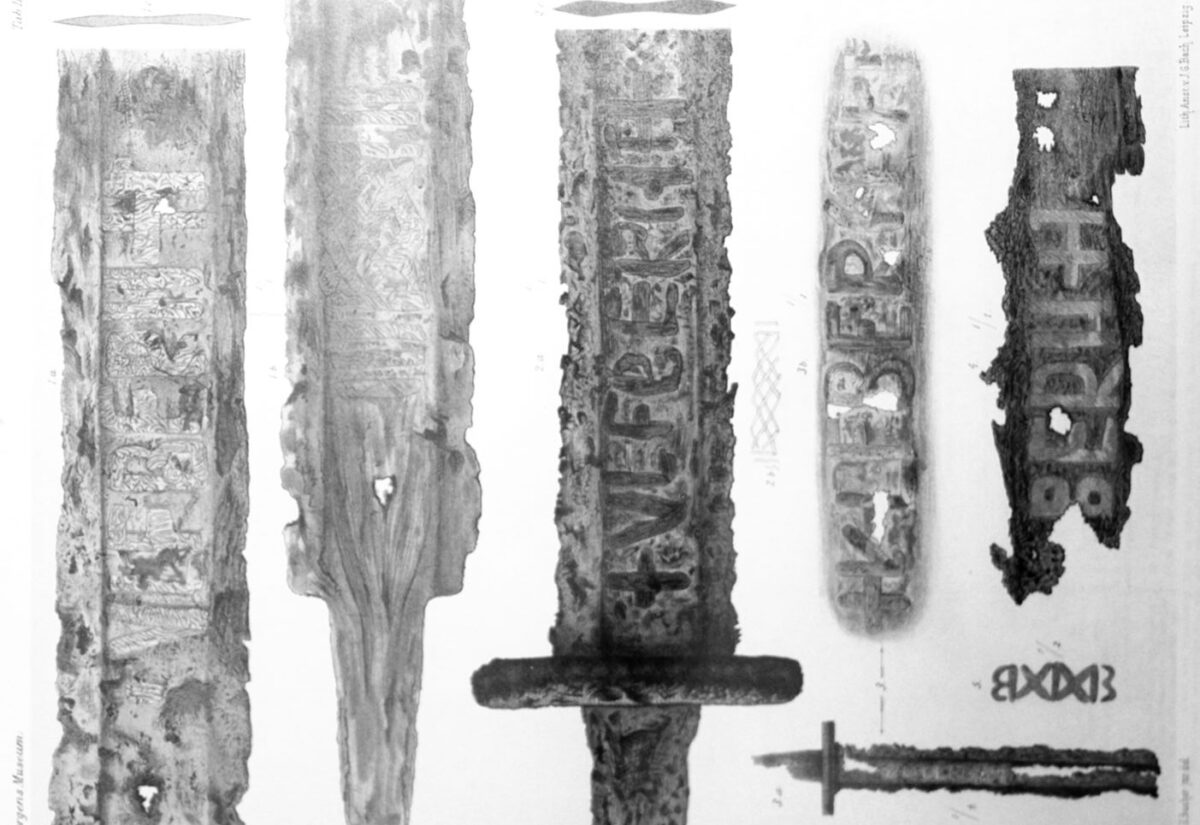
Medieval Viking swords inscribed with the word “+ULFBERH+T” have turned up across Europe, dating from around the 9th to 11th centuries. The mystery lies in the metal—the steel is of such high quality that it shouldn’t have been possible to produce in Europe at the time.
These swords were made from crucible steel, similar to what was produced much later in places like India. How the makers of Ulfberht swords gained access to such technology remains an open question. Documentaries and metallurgical studies have explored the swords’ origins, but many details remain unclear.
History doesn’t always give up its secrets easily. These finds challenge our assumptions, tease our imaginations, and perhaps most importantly, remind us that there’s still so much we don’t know. Whether it’s ancient engineering, mysterious manuscripts, or strange stone carvings, some questions may never be answered, and that’s part of what makes the past so endlessly fascinating.