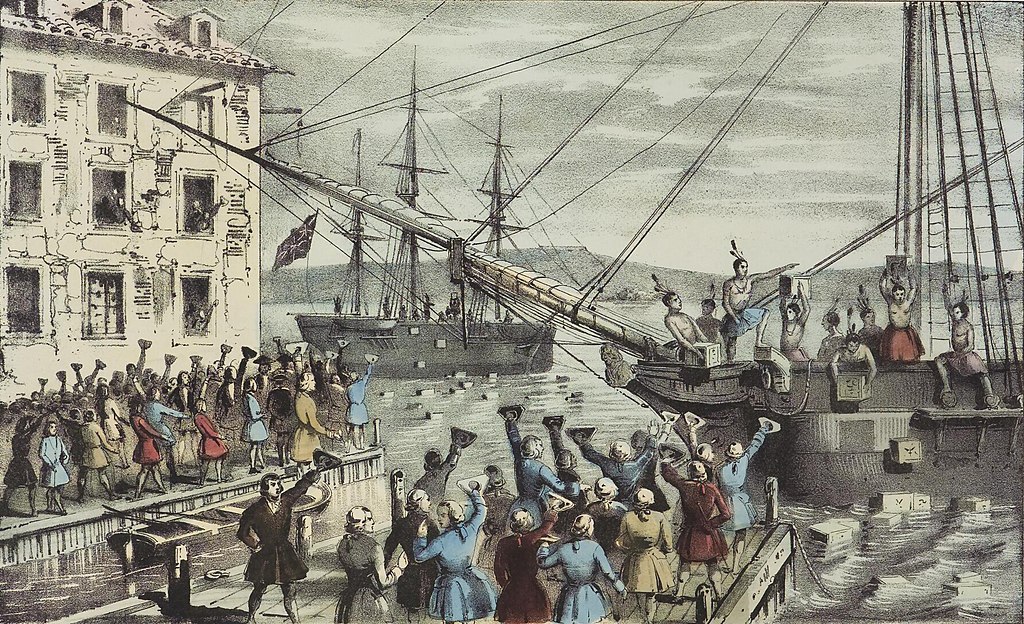
 Nathaniel Currier, Public domain, via Wikimedia Commons
Taxes have always been part of the fabric of civilisation, but sometimes they’ve pushed people too far. While everyone expects to pay something to keep governments running, history is packed with examples of taxes that were so outrageous, illogical, or plainly unfair that they sparked uprisings, riots, and in some cases, full-blown revolutions. Here’s a look at some of the most ridiculous taxes that backfired badly, showing just how fast resentment can turn into rebellion.
The window tax – England, 1696
The English government introduced the window tax as a way to raise money without appearing to tax income directly. The idea was that wealthier people had bigger houses with more windows, so more windows meant more tax. It sounded logical at the time.
But the law led to absurd consequences. People bricked up their windows to avoid paying more, turning beautiful homes into dark, unhealthy spaces. Poorer households were penalised too, even when they only had a few small windows. The tax became deeply unpopular and was associated with government overreach. It stayed in place until 1851 but left a long trail of resentment. In some parts of England, you can still see the bricked-up windows today.
The salt tax – France, pre-revolution
In the years leading up to the French Revolution, the gabelle (salt tax) was one of the most hated taxes in the country. Salt was essential for preserving food, so it hit everyone. But what made it worse was that people couldn’t just buy it freely—they were required by law to buy a certain amount of salt from state sellers at inflated prices.
Enforcement was harsh, and smuggling became rampant. The tax disproportionately affected peasants, while nobles and clergy were often exempt. It became a symbol of everything wrong with the Ancien Régime: unfair, invasive, and corrupt. Unsurprisingly, getting rid of the gabelle became a rallying cry during the revolution.
The beard tax – Russia, 1698
When Tsar Peter the Great wanted to modernise Russia, he looked west, and decided that facial hair had to go. In an attempt to encourage Western-style grooming, he imposed a beard tax on men who wanted to keep their facial hair.
People had to carry a special token to prove they’d paid, and those without one could be forcibly shaved. For devout Orthodox Christians, beards were a symbol of piety, so the tax sparked resistance on both cultural and religious grounds. It didn’t lead to outright revolt, but it certainly caused tension and resentment, and added one more reason for people to mistrust the crown’s reforms.
The hearth tax – England, 1662
The hearth tax charged people based on the number of fireplaces in their homes. Like the window tax, it was meant to be a proxy for wealth, but it ended up punishing ordinary families. Assessors had the legal right to enter homes to count hearths, which people saw as a serious invasion of privacy.
The tax became deeply unpopular, especially during hard winters when heating was essential. Some families even blocked up fireplaces or destroyed them to reduce their liability. The resentment it stirred helped fuel wider discontent with the government and was eventually one of the many pressures that led to its abolition in 1689.
The poll tax – England, 1381
The Peasants’ Revolt of 1381 had many causes, but the final spark was the poll tax—a flat-rate tax that hit everyone, regardless of income. It had been introduced to fund wars in France and was deeply unpopular from the start.
The third version of the poll tax was the breaking point. Tax collectors were sent across the country to squeeze money out of struggling communities, often with brutal tactics. The result was a violent uprising, with thousands of peasants marching on London, demanding reforms. The revolt was eventually crushed, but the message was clear: people wouldn’t tolerate unfair and aggressive taxation.
The tea tax – American colonies, 1773
The British government’s tax on tea wasn’t the highest or the harshest, but it became a flashpoint for colonial resistance. It wasn’t just about money—it was about power. The colonists were being taxed by a parliament in which they had no representation, and that became the real issue.
When the Tea Act was passed, it gave the East India Company a monopoly and kept taxes in place that many colonists saw as illegitimate. The Boston Tea Party, where protestors dumped tea into the harbour, became a turning point. It helped spark the American Revolution and proved that even a fairly minor tax could have massive consequences when it hit a nerve.
The brick tax – England, 1784
This odd tax was based on the number of bricks used in construction. Builders were taxed per brick, which led to some wildly creative attempts to get around it. Bricks became larger to reduce the number needed, and some buildings were made using irregular or oversized bricks.
The tax discouraged new construction and made housing more expensive. It was eventually repealed in 1850, but it left behind a legacy of strange architecture and a deep frustration with tax policy that felt out of touch with everyday life.
The soap tax – Britain, 1712
Soap was taxed as a luxury good, even though it was essential for hygiene. The tax lasted for over 100 years and disproportionately affected poorer households, who could barely afford to buy soap as it was.
Because the tax was collected at the point of production, it also limited who could manufacture soap. Only licensed producers could operate, and the licence was expensive. This reduced competition and kept prices high. The tax was finally abolished in 1853, but it’s often cited as one of the most short-sighted taxes in British history.
The salt tax – India under British rule
The British monopoly on salt in India was another example of a tax that hit a nerve. Salt was essential for survival, and yet the colonial government controlled its production and sale. Indians had to buy it from British sources, and making your own was illegal.
Mahatma Gandhi famously led the Salt March in 1930, walking 240 miles to the Arabian Sea to symbolically make salt in defiance of the law. The protest sparked mass civil disobedience across the country and became a turning point in the independence movement. It was a simple protest against a simple substance, but it carried enormous weight.
Why these taxes backfired
The thing about a bad tax isn’t always the amount—it’s the principle. People will pay when they see fairness, representation, or necessity. But when a tax feels petty, invasive, or unjust, it can ignite something much bigger.
These taxes weren’t just unpopular, they were catalysts. They pushed already strained societies to the edge and often became shorthand for everything people hated about those in power. And when that happens, even a tax on soap or salt can light the match that burns everything down.