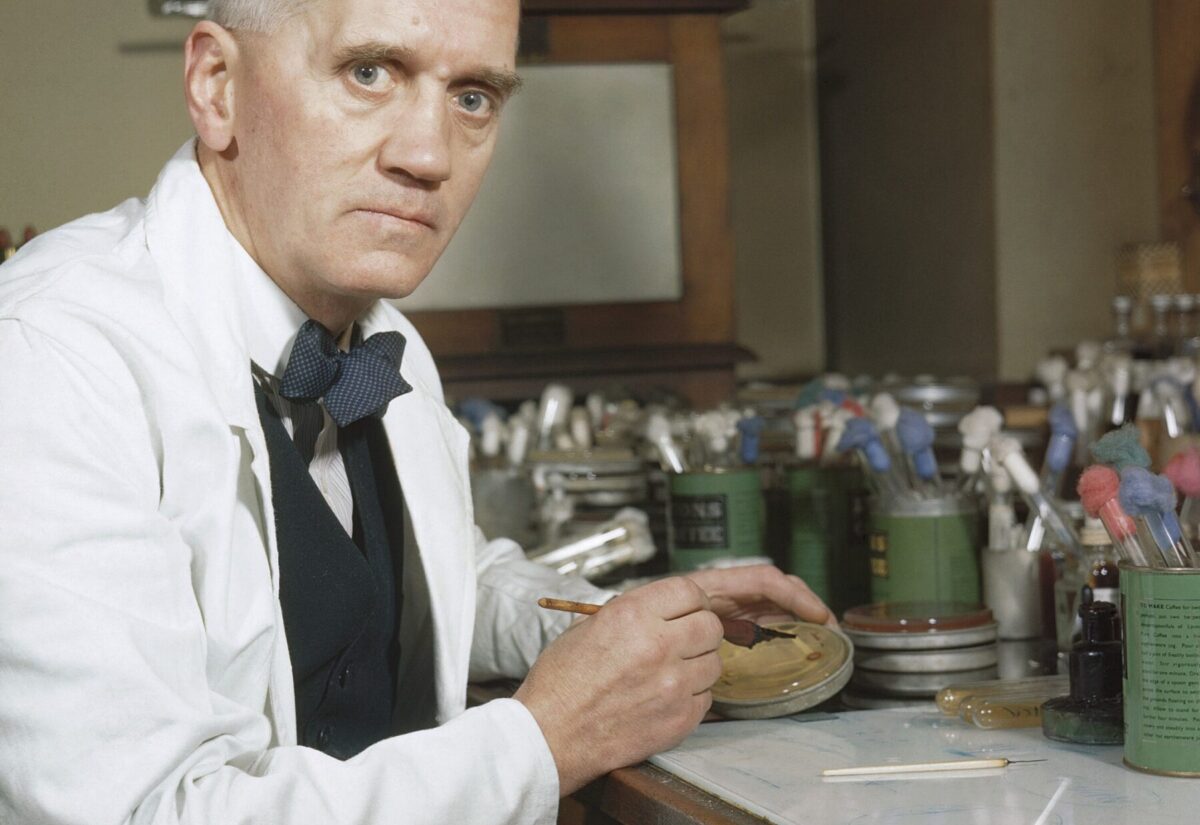
 Official photographer, Public domain, via Wikimedia Commons
Some of the most important breakthroughs in human history didn’t happen because someone set out to change the world. They happened accidentally, during a mistake, a side project, or a routine task. These accidental discoveries ended up transforming how we live, eat, heal, and even communicate. Here are some of the most remarkable examples of world-changing inventions that no one actually meant to make.
Penicillin
In 1928, Alexander Fleming returned from holiday to find a petri dish in his lab contaminated with mould. Instead of throwing it out, he noticed the mould had killed the bacteria around it. That mould turned out to be Penicillium notatum, and it would go on to save millions of lives as the world’s first widely-used antibiotic.
Fleming’s initial discovery wasn’t immediately appreciated, and it took a decade, and the efforts of other scientists, to turn penicillin into a mass-producible drug. But its accidental origin marked a turning point in medicine. Before antibiotics, even minor infections could be fatal. After penicillin, modern medicine had a new line of defence.
Microwave cooking
In the 1940s, engineer Percy Spencer was working on radar equipment when he noticed something odd: a chocolate bar in his pocket had melted. Intrigued, he began experimenting and found that microwave energy could cook food. His tests included popcorn, and eventually an egg that exploded in a colleague’s face.
This led to the invention of the microwave oven, which revolutionised how people cook and reheat meals. What started as a strange side effect of radar technology became a kitchen staple.
X-rays
In 1895, Wilhelm Röntgen was experimenting with cathode rays when he noticed that a fluorescent screen across the room started to glow, even though it shouldn’t have. Through further tests, he discovered that invisible rays were passing through solid objects and leaving images on photographic plates.
These “X-rays” (he named them with the algebraic unknown “X”) quickly changed medical diagnostics forever. For the first time, doctors could see inside the body without surgery. Röntgen’s accidental discovery earned him the first Nobel Prize in Physics.
Vulcanised rubber
In the early 1800s, Charles Goodyear was obsessed with rubber, but it kept melting in the summer and cracking in the winter. One day, by pure chance, he spilled a mixture of rubber and sulphur onto a hot stove. Instead of melting, the rubber hardened and became flexible and durable.
This was the beginning of vulcanised rubber, which became essential for tyres, waterproof clothing, and countless industrial products. Goodyear didn’t get rich from his discovery, but the impact of his accidental breakthrough is everywhere.
Safety glass
In 1903, French chemist Édouard Bénédictus dropped a glass flask coated in plastic cellulose nitrate. Instead of shattering, the glass cracked but held its shape. Inspired by this, he began developing laminated safety glass. The invention was initially used in car windshields, where it prevented injuries from flying glass during accidents. Today, safety glass is used in everything from vehicles to building windows and phone screens. All thanks to a dropped flask.
Saccharin
In 1879, researcher Constantin Fahlberg forgot to wash his hands after a long day in the lab. While eating dinner, he noticed everything tasted oddly sweet. He realised the compound he’d been working with, saccharin, was responsible. Saccharin went on to become one of the first artificial sweeteners. Though it sparked health debates over the years, it also helped people reduce sugar intake and paved the way for a whole industry of sugar substitutes.
Pacemakers
Engineer Wilson Greatbatch was working on a device to record heart rhythms when he accidentally installed the wrong resistor. Instead of recording a signal, the circuit emitted a rhythmic electrical pulse. He realised it could be used to regulate heartbeats.
Greatbatch spent years refining the device, eventually creating the first implantable cardiac pacemaker. What started as a mistake now helps millions of people live longer and healthier lives.
Plastic
Plastic as we know it owes a lot to accidents. In the early 20th century, chemist Leo Baekeland was experimenting with synthetic resins. His goal was to create a better electrical insulator, but what he stumbled onto was Bakelite—the first fully synthetic plastic.
Bakelite was heat-resistant, mouldable, and didn’t conduct electricity. It changed manufacturing forever, leading to the development of modern plastics used in everything from electronics to packaging.
Teflon
In 1938, chemist Roy Plunkett was trying to create a new refrigerant when he discovered that one of his gas canisters had stopped releasing pressure. When he opened it, he found a slippery white substance inside that resisted heat, water, and chemicals.
That substance was polytetrafluoroethylene, better known as Teflon. It was later used in everything from non-stick pans to spacecraft and industrial coatings. What was supposed to be a refrigerant became one of the most versatile materials of the modern age.
Play-Doh
Play-Doh began life as a wallpaper cleaner. In the 1930s, it was sold to remove coal soot from walls. But as homes switched to cleaner heating systems, sales dropped. In a lucky twist, teachers discovered that the soft, non-toxic putty was perfect for arts and crafts. The company rebranded it as a toy in the 1950s, added colours and scents, and it became a staple of childhood playrooms. It wasn’t the product they set out to sell, but it ended up being far more successful.
Conclusion
These accidental discoveries show that some of humanity’s biggest leaps forward came from mistakes, coincidences, or happy accidents. What mattered wasn’t just the error; it was the curiosity and insight to recognise something useful in the unexpected. Whether it’s medicine, technology, or even toys, chance has played a surprisingly big role in shaping civilisation as we know it.