Strange Historical Pregnancy Tests Involving Frogs, Wheat, Onions, And More
- July 7, 2025
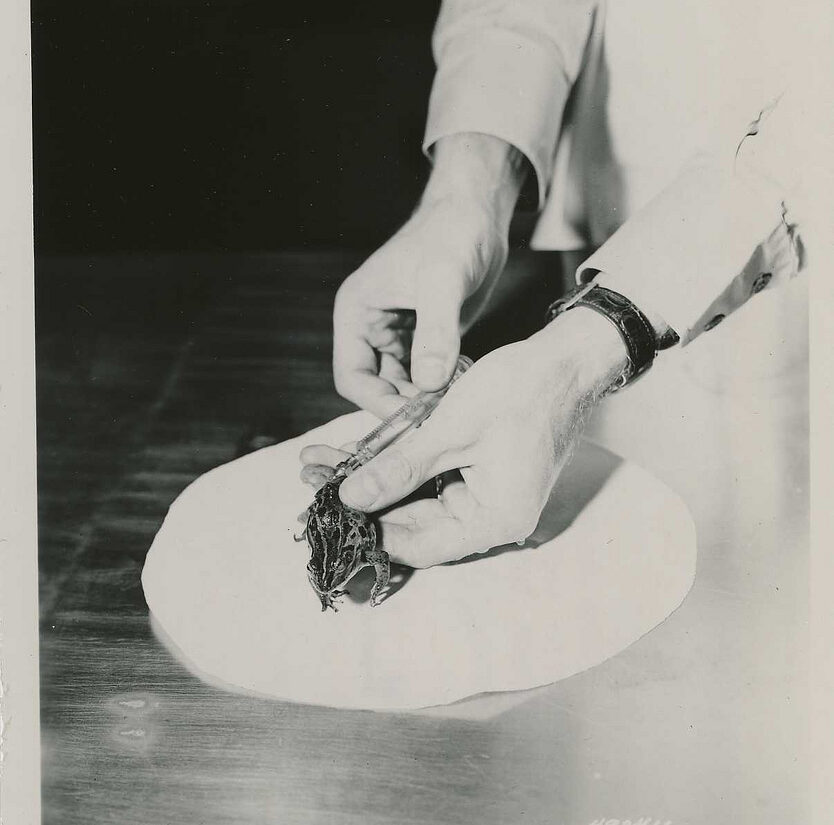 Otis Historical Archives of “National Museum of Health & Medicine” (OTIS Archive 1), CC BY 2.0 , via Wikimedia Commons
Long before over-the-counter pregnancy tests existed, people had to rely on whatever they had on hand, and some of their methods were both surprisingly creative and undeniably odd. Across different civilisations and centuries, various cultures came up with ways to test for pregnancy using animals, plants, and even vegetables. These tests were often based on anecdotal evidence and trial and error, but some turned out to have more logic behind them than you’d expect. Here’s a look at some of the strangest methods used to determine pregnancy throughout history.
The ancient Egyptian wheat and barley test
One of the earliest recorded pregnancy tests comes from ancient Egypt, around 1350 BCE. Women were instructed to urinate on a mixture of wheat and barley seeds over the course of several days. If the seeds sprouted, the woman was thought to be pregnant. Even more oddly, the type of grain that sprouted was believed to predict the baby’s sex: wheat for a girl, barley for a boy.
This might sound completely implausible, but a 1963 study found that, in some cases, the urine of pregnant women could indeed promote seed growth due to increased levels of oestrogen. While it certainly wasn’t foolproof, it wasn’t as far-fetched as it first appears.
The frog test that changed modern medicine
In the 1930s, scientists developed a pregnancy test that involved injecting a woman’s urine into a female African clawed frog. If the woman was pregnant, the frog would ovulate and produce eggs within 24 hours. This worked because the hormone hCG (present in pregnant urine) stimulates ovulation in the frog.
Known as the Hogben test, it was actually more accurate than many of its predecessors and became widely used until laboratory testing techniques became more sophisticated in the 1960s. Some labs reportedly kept tanks of frogs for just this purpose. It might sound bizarre now, but this method marked a major step forward in hormone-based pregnancy detection.
Onions and the theory of the womb’s breath
In ancient Greece, one pregnancy test involved placing a peeled onion or other pungent vegetable in the woman’s vagina overnight. If she awoke with onion breath, it was believed that her womb was open (a sign she was not pregnant). If no smell reached the mouth, it suggested that pregnancy had closed the womb.
The theory hinged on the idea that women’s bodies had internal airflow and that pregnancy altered this circulation. Of course, there’s no scientific basis for this method, but it does show how determined ancient societies were to make sense of internal biology using whatever indicators they could find.
Rabbit tests that weren’t great for the rabbit
Before frogs were widely used, rabbits bore the brunt of early hormone testing. In the 1920s, a test was developed in which a woman’s urine was injected into a female rabbit. If the rabbit’s ovaries showed certain changes after being dissected a few days later, it indicated pregnancy.
The phrase “the rabbit died” became a euphemism for a positive result, though, tragically, the rabbit always died, as there was no way to check the ovaries without killing it. While the test was a breakthrough in its time, it also sparked ethical concerns that eventually led to less invasive methods.
Medieval urine analysis by colour and smell
In medieval Europe, physicians would examine a woman’s urine for changes in colour, clarity, and even scent. It was believed that sweet-smelling urine or urine with a pale, cloudy appearance could be signs of pregnancy. Sometimes, urine was compared to charts of known symptoms, or mixed with wine to observe chemical reactions.
Though mostly guesswork, the wine test in particular may have had a small amount of merit. Alcohol can interact with certain proteins and hormones, causing subtle changes in consistency. But for the most part, these observations were more about pattern recognition than reliable science.
Key and lock charms as early superstition
In some parts of mediaeval Europe, women would carry or sleep with charms—often keys, locks, or small metal objects believed to influence conception or reveal pregnancy. One such folk test involved placing a small key in a woman’s hand while she slept. If she dreamed of unlocking something, she was thought to be expecting.
These symbolic practices reflect more about cultural attitudes to fertility and superstition than any biological insight, but they were deeply meaningful to the people who relied on them.
India’s mustard seed test
In certain parts of India, mustard seeds were used in home pregnancy tests. A handful of mustard seeds would be soaked in the woman’s urine and observed for several days. If they sprouted, it was taken as a sign of pregnancy.
This method echoes the logic of the ancient Egyptian grain test and again ties into the hormonal composition of urine. While modern tests are obviously far more reliable, these rudimentary experiments show a surprising level of observational curiosity and experimentation.
While none of these historical methods would pass clinical trials today, many of them were rooted in practical observation and a desire to understand the body’s changes. They reflect a time when science, superstition, and medicine overlapped, and when people made do with the tools they had. Some methods, like the use of frogs and grains, even laid the groundwork for more advanced hormonal testing in the future. Strange as they are, these tests offer a fascinating glimpse into the history of human ingenuity and the age-old question: am I pregnant?