 Unsplash/Aaron Greenwood
Not every historical wonder was the result of a planned expedition or years of careful digging. Some of the most remarkable sites in the world were found completely by chance—stumbled upon by farmers, builders, hikers, or even children. These discoveries rewrote history and reminded us how much of our past is still hidden beneath our feet. Here are some of the most awe-inspiring historical sites that came to light purely by accident.
The Terracotta Army, China
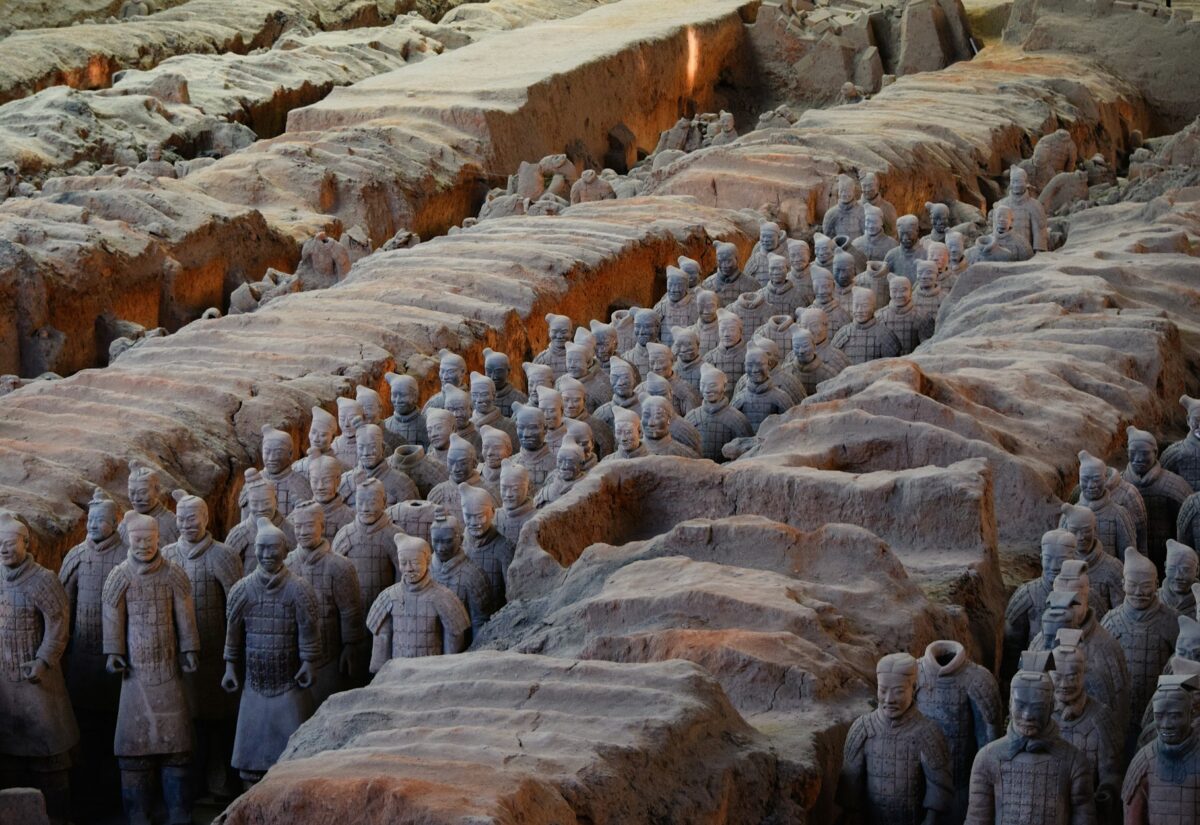
In 1974, a group of farmers digging a well in Xi’an made a discovery that would become one of the most important archaeological finds of the 20th century. What they thought was just a broken piece of pottery turned out to be the tip of an underground mausoleum filled with thousands of life-sized clay soldiers—each one unique.
The Terracotta Army was created over 2,000 years ago to guard the tomb of China’s first emperor, Qin Shi Huang. The site eventually revealed warriors, horses, weapons and even acrobats, all buried in precise formation. What started as a routine farming task led to the unearthing of an entire underground empire. The site is now a UNESCO World Heritage Site and draws millions of visitors each year.
Lascaux Caves, France
In 1940, four teenage boys chasing their dog in the countryside near Montignac stumbled into a cave system. Inside, they found some of the most exquisite and well-preserved prehistoric art ever discovered. The Lascaux Caves contain over 600 paintings and 1,500 engravings of animals, human figures and abstract symbols, thought to be over 17,000 years old.
The discovery gave historians an unprecedented glimpse into early human life, beliefs, and artistry. Though the original caves have been closed to the public since the 1960s to prevent further damage, a replica site allows people to experience the wonder without harming the delicate environment. More about the discovery and preservation efforts can be found through UNESCO’s official site.
Pompeii, Italy
The city of Pompeii was buried under volcanic ash in AD 79 after Mount Vesuvius erupted. For centuries, its precise location was lost to history, until excavations in the 18th century revealed a hauntingly preserved Roman city. But one of the earliest accidental finds occurred in the 1590s, when architect Domenico Fontana was digging a canal and struck ancient walls covered in frescoes.
Initially, the significance wasn’t understood, and the area was largely ignored. It wasn’t until the 1740s that full-scale excavations began. The site has since uncovered homes, temples, shops, and even graffiti, offering an unparalleled snapshot of everyday Roman life. Pompeii continues to be a key archaeological site, and new discoveries are still being made as recently as 2020.
Machu Picchu, Peru
Nestled in the Andes Mountains, Machu Picchu remained hidden for centuries. Although local communities knew of its existence, it wasn’t widely known to the outside world until 1911, when American historian Hiram Bingham was led to the site by local farmers. He was actually searching for another lost city entirely—Vilcabamba—but instead stumbled upon what is now one of the most iconic Incan ruins.
Built in the 15th century, Machu Picchu features temples, terraces, and palaces set against a breathtaking mountain backdrop. It’s since become one of the most visited archaeological sites in the world. Bingham’s journey, while often romanticised, was shaped by luck, local knowledge and sheer perseverance.
Skara Brae, Scotland
In 1850, a violent storm battered the Orkney Islands off the north coast of Scotland. As the winds died down, locals noticed that the storm had exposed a series of stone structures buried in the earth. What they had found was Skara Brae, a remarkably well-preserved Neolithic village dating back over 5,000 years.
Complete with stone beds, dressers, and even a primitive drainage system, the site offered extraordinary insight into prehistoric life. Skara Brae is now part of the Heart of Neolithic Orkney World Heritage Site and stands as one of the best-preserved settlements of its time anywhere in Europe.
Göbekli Tepe, Turkey
In the 1990s, a Kurdish shepherd in southeastern Turkey noticed a large stone protruding from the ground. He contacted local archaeologists, and soon a German-Turkish team realised they had discovered something extraordinary: the world’s oldest known temple complex.
Göbekli Tepe dates back over 11,000 years—predating Stonehenge by millennia. The site features massive stone pillars arranged in circles, carved with animal figures and symbols. What makes it especially fascinating is that it was built by hunter-gatherers, long before agriculture was thought to have developed. The discovery is still challenging assumptions about the development of civilisation. More on the implications of this site is discussed on the UNESCO World Heritage site.
The Rosetta Stone, Egypt
During Napoleon’s campaign in Egypt in 1799, a French soldier discovered a large slab of rock while helping to build a fort near the town of Rosetta (modern-day Rashid). That slab turned out to be the Rosetta Stone—inscribed with the same text in three scripts: Greek, Demotic and Egyptian hieroglyphs.
The stone became the key to unlocking ancient Egyptian writing, allowing scholars like Jean-François Champollion to finally decode hieroglyphs after centuries of mystery. Without this accidental find, our understanding of ancient Egypt would be far more limited.
Altamira Cave, Spain
In 1868, a hunter stumbled upon the entrance to Altamira Cave, but it wasn’t until several years later that archaeologists realised its significance. In 1879, a Spanish nobleman’s young daughter, María, was exploring the cave when she looked up and exclaimed that the ceiling was covered in painted bison.
At first, the authenticity of the paintings was questioned. Many experts believed they were too sophisticated to have been made by prehistoric people. But later carbon dating confirmed they were at least 14,000 years old. The find changed the way historians thought about prehistoric humans and their artistic capabilities.
Derinkuyu, Turkey
In the 1960s, a man renovating his home in the Turkish town of Derinkuyu knocked down a wall and discovered a hidden room. Behind that room was another—and another—until he realised he’d found the entrance to an entire underground city.
Derinkuyu is a multi-level complex that could house up to 20,000 people, complete with stables, chapels, kitchens and air shafts. It was likely used by early Christians fleeing persecution. What makes it especially astonishing is its depth and engineering—the entire city was carved from rock by hand. And it was completely forgotten until one man started knocking through a wall in his basement.
Sutton Hoo, England
In 1939, Edith Pretty, a landowner in Suffolk, asked an archaeologist to investigate a series of mysterious mounds on her estate. What they found was the remains of a ship burial from the early medieval period, containing weapons, gold, and a distinctive helmet that’s now one of the British Museum’s most famous artefacts.
Sutton Hoo revealed a sophisticated Anglo-Saxon culture that had been largely overlooked until then. It helped bridge the gap between myth and early British history. The discovery was the subject of the 2021 film The Dig, which highlights the strange mix of amateur curiosity and historical importance that defined the find.
The Dead Sea Scrolls, Israel
In 1947, a Bedouin shepherd threw a rock into a cave near the Dead Sea and heard the sound of pottery breaking. When he climbed in to investigate, he found clay jars containing ancient scrolls. These would become known as the Dead Sea Scrolls—over 900 texts including biblical manuscripts, hymns and legal documents from the 3rd century BCE to the 1st century CE.
The scrolls have provided invaluable insight into Judaism, early Christianity, and the diversity of religious thought at the time. Many of them were incredibly well preserved thanks to the arid climate of the caves. The discovery reshaped biblical scholarship and historical research for generations to come.
Accidental discoveries remind us that history isn’t always something we seek—it often finds us. Whether buried under ash, tucked inside caves or hidden beneath someone’s home, the past has a habit of revealing itself when we least expect it. And with so many stories still buried, there’s always the chance that the next breakthrough might be waiting just beneath the surface.