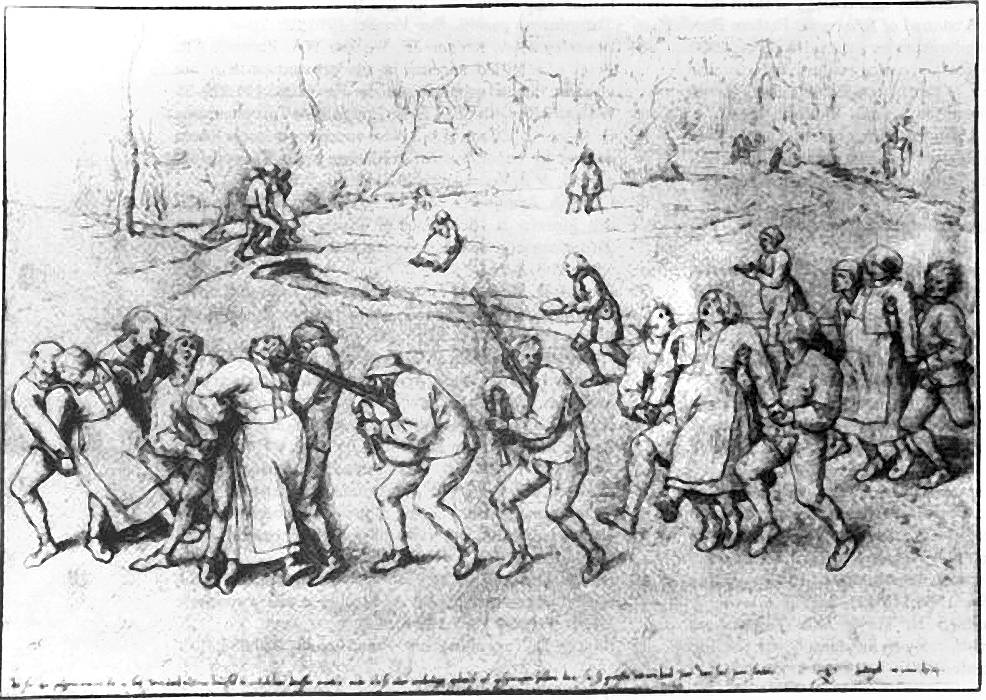
 Pieter Breugel de Oude, Public domain, via Wikimedia Commons
When people think of hysteria, they tend to picture individuals acting irrationally. But history shows that entire communities—even whole towns—have at times been swept up in strange, unexplainable waves of behaviour. From convulsions and dance frenzies to phantom attackers and shared delusions, mass hysteria is a curious intersection of fear, stress, belief and biology. It’s happened across centuries and continents, and while science has given us some answers, many cases still leave more questions than explanations.
The dancing plague of 1518
One of the most bizarre events in European history took place in Strasbourg (then part of the Holy Roman Empire) when a woman began dancing uncontrollably in the street. Within a week, dozens more had joined her. Over the course of a month, up to 400 people were reportedly dancing day and night, with several collapsing from exhaustion—some even dying.
At the time, authorities thought the dancers were suffering from a hot blood condition and encouraged more dancing to sweat it out. Modern theories suggest stress-induced psychogenic illness, mass trauma after a series of famines and plagues, or even possible food poisoning caused by ergot, a hallucinogenic fungus that can grow on damp rye. The dancing plague remains one of the most peculiar and well-documented cases of mass hysteria. You can read more about it via BBC Future.
The Salem witch trials
Between 1692 and 1693, the town of Salem, Massachusetts, became the centre of one of the most infamous witch-hunting episodes in history. A group of young girls began displaying strange behaviours—seizures, screaming, claiming to see spirits. As fear spread, accusations flew, and by the time it was over, more than 200 people had been accused of witchcraft. Nineteen were hanged and one man was pressed to death.
While often discussed as a moral panic or religious extremism, the Salem events have also been interpreted as a classic example of mass hysteria. Some researchers suggest the girls may have been experiencing a psychosomatic reaction to extreme societal pressure, fear of the Devil, and the strict Puritan rules of their time. Others suggest poisoning or social rivalry played a role. Either way, it was a deadly collision of belief and fear.
The Tanganyika laughter epidemic
In 1962, three schoolgirls in what is now Tanzania started laughing uncontrollably. Their laughter spread quickly to other pupils, then to neighbouring villages. At its height, more than 1,000 people were affected, with schools forced to close as people suffered laughing fits that lasted for hours—even days. Some also experienced rashes, fainting and crying.
Doctors were baffled. No physical cause was found. The most likely explanation was mass psychogenic illness brought on by stress. The country had recently gained independence and was dealing with enormous social change. In such a tense climate, the laughter became contagious—not from joy, but from nervous release. It’s one of the few cases of hysteria that was documented almost in real time. The story is still cited in medical and psychological studies today.
The Halifax slasher scare
In 1938, the British town of Halifax, West Yorkshire, was gripped by terror after several people reported being attacked by a mysterious man wielding a razor. Panic quickly spread as more victims came forward with similar stories—many claiming to have been cut or slashed. The press ran with it, and the town became paralysed by fear.
But things unravelled when one of the alleged victims admitted they had fabricated their injuries. Before long, it became clear that most of the reports were false. There was no slasher. It was a mass case of shared delusion, fuelled by anxiety, media attention and fear. The police arrested several people for wasting their time, and the incident became one of Britain’s most famous cases of moral panic.
The meowing nuns of France
In a French convent during the Middle Ages, a group of nuns began meowing like cats. One nun started it, but soon the entire convent was affected. They meowed at regular intervals for hours on end. Locals were confused, and eventually the army had to intervene. The bizarre behaviour stopped shortly after soldiers threatened punishment.
Historians believe the incident may have been sparked by stress or strict discipline. The convent environment, already socially isolating and intensely religious, created the perfect conditions for a form of mass psychogenic illness. Animal mimicry wasn’t unheard of in these cases—there were similar reports across Europe of nuns barking or behaving like dogs.
The June bug epidemic of 1962
In a US textile factory, dozens of workers reported symptoms like nausea, dizziness and skin rashes. Many believed they had been bitten by a mysterious insect, nicknamed the “June bug.” The factory was shut down, fumigated, and health officials investigated. But no bugs were ever found, and scientists couldn’t detect any toxins or contaminants.
Eventually, the Centres for Disease Control concluded the outbreak was a case of mass hysteria, brought on by high stress, fatigue and perhaps even the power of suggestion. Once the idea of a bug took hold, symptoms spread quickly through the close-knit workforce. The case is still studied in occupational health circles today as an example of how stress and fear can cause very real physical symptoms.
The Pokémon panic in Japan
In 1997, a Pokémon episode aired in Japan that caused hundreds of children to experience seizures, nausea, and vision problems. Over 600 were taken to hospital, with 150 admitted. The culprit? A scene involving rapidly flashing red and blue lights. While the initial cause was photosensitive epilepsy in a small number of viewers, the sheer scale of hospital admissions suggested something more.
Experts believe that many of the later symptoms were psychosomatic. Once news spread that children were collapsing after watching the episode, anxiety took over. Parents and kids alike became convinced they were ill—even if they hadn’t watched the full scene. The event is now cited as an example of “mass psychogenic illness amplified by media,” as explored in reports like those from the National Library of Medicine.
The West Bank fainting epidemic
In 1983, hundreds of Palestinian schoolgirls in the West Bank suddenly began fainting, complaining of headaches and nausea. Israeli authorities initially suspected a chemical attack. Panic surged, with even adult staff and soldiers reporting symptoms. But no toxins were found.
The Israeli and Palestinian authorities gave conflicting explanations. Some said it was psychological stress from the tense political climate. Others believed it was fear of chemical warfare. In the end, most experts agreed it was a case of mass hysteria, driven by the pressures of occupation, school stress, and environmental anxiety. It’s still considered one of the most politically complicated examples of mass psychogenic illness.
The medieval biting nuns
Similar to the meowing convent incident, several accounts from the 15th and 16th centuries tell of nuns who began biting each other, often violently. The phenomenon spread from one convent to the next across Germany, the Netherlands and parts of France. Local priests and even bishops were called in to intervene, and exorcisms were performed.
These incidents often happened in highly restrictive environments with young women who had little control over their lives. The acts of biting were likely expressions of repressed frustration and stress. The contagion of behaviour speaks to how a single unusual act could ripple through an entire community in close quarters.
The school fainting crisis in Malaysia
In the 1980s and 90s, multiple schools in Malaysia reported mysterious fainting episodes, mostly among teenage girls. The girls would often claim to see ghostly figures or feel a supernatural presence. These outbreaks disrupted classes, required police and religious intervention, and sometimes even led to school closures.
The cultural context played a major role. Beliefs in spirits or jinn are common in Malaysian folklore, and the pressure on students was immense. Experts believe the fainting spells were a form of mass dissociation triggered by stress, reinforced by shared beliefs and local superstition. Even today, such incidents occasionally occur and are treated with both medical and spiritual care.
Mass hysteria, or mass psychogenic illness, often emerges in moments of tension—when uncertainty, fear and suggestion collide.
What’s striking is how symptoms can spread without any physical cause. The human mind is deeply social, and under the right conditions, a single reaction can ripple outward, infecting an entire community.
Whether through laughter, meowing, fainting, or dancing to the point of collapse, these events reveal how much we’re influenced by those around us. And while our understanding of mental health and collective psychology has come a long way, history reminds us that hysteria—like a virus—has always been part of the human story.